As we continue to process Cooper’s death, navigate grief, and struggle our way toward, through, and around healing, I am leaning into music.
I’ve never been a huge music guy, but I am finding that music touches me in places other mediums do not. My soul, man.
I tear up listening to certain songs, but they are good tears. I lean my head back and show my whole face to Creation and let the tears stream down my cheeks.
I learned about lifting my head up and proudly showing my crying face while watching the documentary The Work.1 I highly recommend this documentary. I wish there had something like this when I left the fire department; it would have been healing.
It would be healing now.
I do think sometimes men just need another man standing in front of them, staring them in the eyes, saying, “I got you. Let’s go pick up the coins in the deep places.”
Here are two more songs to add to my growing playlist:
McLeary, J., & Aldous, M. (Directors). (2017). The Work [Film]. The Orchard. ↩︎
I grew up in Arizona, solidly middle class. Or maybe we were lower middle class, and I have more lofty memories than I ought to have. I’m not sure. I snow skied and slam danced. You tell me.
All things considered, our middle-class neighborhood was culturally diverse. My best friend throughout high school was South Korean. His mother was South Korean by birth, and his father was American. My friend’s grandmother, directly from South Korea, lived with his family. It was three generations living together under one roof.
“Grandma” is pronounced “Halmeoni” in Korean. This is what we called my friend’s grandmother, Halmeoni. Halmeoni spoke no English. None. Despite this, Halmeoni took on a grandmotherly role for me. When I visited my friend, which was often (he lived around the corner), Halmeoni always wanted to see my hands. She would look at my palms, rub them, and look up at me with her little old round face and smile warmly. I don’t know if she was reading my palms, but I always assumed it was something like that. My friend never told me what she was doing; maybe he didn’t know.
Halmeoni gave me a good feeling about my future. There was nothing in her smile that indicated an easy life, but I’ve always imagined a full and robust life based on what I read in her expressions while she was peering into my palms, or whatever it was she was doing.
I’m told that years later, on her deathbed, Halmeoni said my name, “Kelly.” She said it a few times. I miss Halmeoni. She was a good grandmother to me.
Fast forward a few years. I am a young man now, a firefighter, and I am married with three small children—all boys at this point. Little Miss Sunshine (Grace), our daughter, was still just a twinkle in our eyes. We bought a house in a master-planned community in a cul-de-sac. Yes, I was still rolling solidly middle class. Or, you know, I am recalling life more loftily than I ought.
There were seven homes in the cul-de-sac. If you’re into numbers, it’s not a bad set.
Our immediate neighbors to the south were Orthodox Christians from Assyria. They fled their home country under extreme persecution. We immediately hit it off with this family. In fact, they called us family. They said, “If we have a problem and need help, our family, who lives many miles away, cannot help us. But you, you can help us. Therefore, you are now our family.” It was a simple logic that made sense to me. Like my friend growing up, there were three generations living in this home. I had, once again, another grandma and grandpa. Grandpa Otto always wanted to shake my hand and stand in front of me, holding our handshake and smiling. This was our greeting. Like Halmeoni, my new grandparents spoke no English. We spent a lot of time with our neighbors eating and drinking, and the kids played together safely in the cul-de-sac.
Across the street in the cul-de-sac was a large Hispanic family. This family also had three generations living under one roof. The grandparents spoke little English. We were friends with this family and spent a lot of time in the cul-de-sac, drinking and smoking hookah with raspberry tobacco, courtesy of our Assyrian family. Their children were older, so our kids didn’t spend as much time together.
These three families, in addition to our many Hispanic/Mexican family and friends, have influenced how I think about multigenerational living. They modeled it very well.
I’ve thought a lot about these families over the years. They were comfortable with their older children and parents living at home, perhaps indefinitely, under one roof. I’ve mentally compared and contrasted my observations of these families with white families. In white culture, which I am a part of, it’s frowned upon for grown children to live at home. Grandparents rarely live at home; they are sent to nursing homes.
As I have labored in the workforce for many years and become a middle-aged man, I know how difficult it is to earn a living, support a family, build a life, and gain upward mobility. It’s increasingly challenging to gain a foothold in life as a young person—even with a college degree and help from family.
By the time Cooper graduated from college in May 2022, we had moved to the Midwest to help care for my father-in-law. This left Cooper a few choices: 1) live with grandma and grandpa in Southern Arizona while job hunting, 2) live with mom and dad in the Midwest while job hunting, or 3) live with friends or brothers while job hunting. The bottom line was that we were no longer paying Cooper’s rent.
As it happened, Cooper landed a job at the university and moved from Southern Arizona to the Midwest, moving in with us. It was a quick, seamless, and smooth transition.
Serendipitously, I had spent the previous year remodeling our basement. The basement has hardwood flooring, a master bedroom with a walk-in closet, a full bath, a kitchen, an island, a workstation, a reading area, a living room, and a workout room. There is a large sliding glass door leading out to a patio area and the backyard. It is fully self-sustaining.
Over the last year, as Cooper lived at home rent-free “in the basement,” he was able to buy a new car, pay for it, and save a decent amount of money. We imagined Cooper would stay with us for one, maybe two years max. We simply told him he could stay as long as he wanted, but we figured it would be about a year. In fact, I came across a goal Cooper had written in his notes: “Goal: leave home by 2024.”
As Cooper lived with us, my old family friends were on my mind. We were breaking with our cultural tradition to live together in a manner that comes more easily to other cultures.
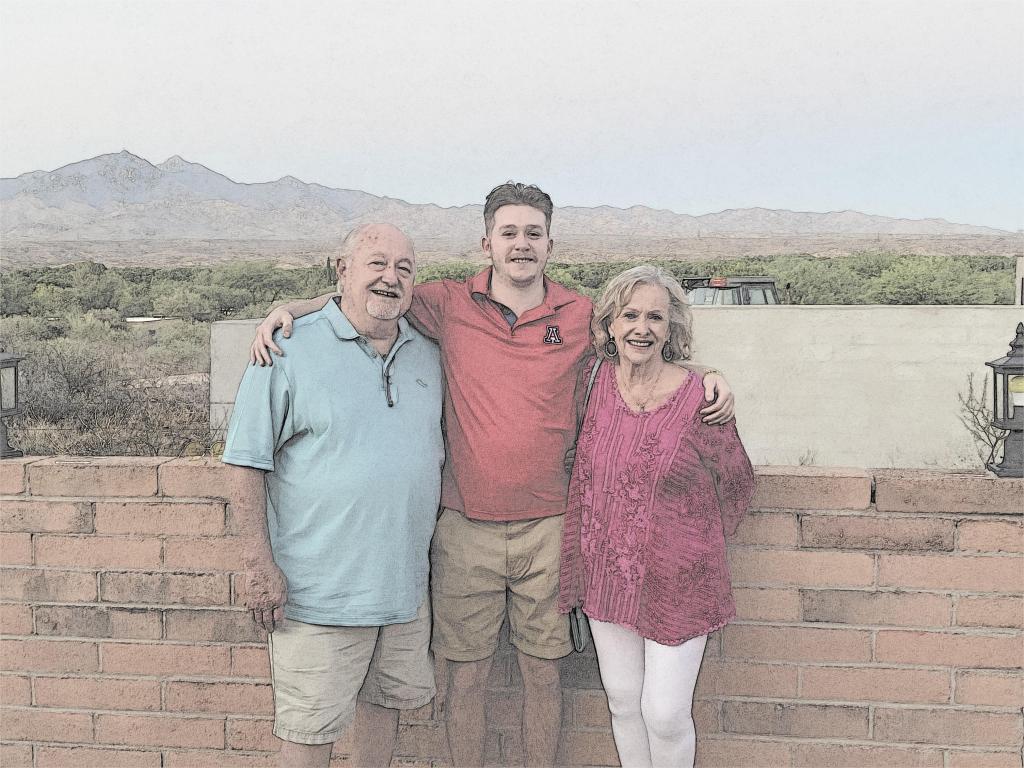
It was nice having Cooper at home with us. We enjoyed his company. He did not spend a lot of time with us upstairs, but we did eat meals together on Sundays. Grandma and grandpa usually drove over and ate Sunday dinner with us, which was nice because Cooper was able to spend quality time with his grandfather before he died of Parkinson’s in May.
(Incidentally, I do think Poppy Jack’s death was one of the more recent triggers influencing Cooper’s decision to take his own life. I will speak more about this in a future post.)
Remember, I have shared that Cooper had social anxiety. He stated in a text to a friend that his social anxiety sometimes caused him “pain” to talk with others. In another text, Cooper mentioned he saw a doctor, and the doctor suggested he might be depressed. On the heels of COVID-19, I know Cooper felt lonely and isolated because he told me so (November 2021).
Cooper, like all of us, wanted to connect with others. He wanted companionship. He wanted a girlfriend. But Cooper was not great at connecting and starting that first initial conversation. It was hard for him. For those who got through that initial social awkwardness and accepted Cooper as he was, he was deeply loved.
As I was going through Cooper’s text messages looking for clues as to why he might have taken his life, and if it was preplanned (it was not), I came across a text exchange, several months old, that bothered me. It continues to bother me, which is why I am writing about it.
I don’t believe the text exchange had anything to do with Cooper taking his life, but I don’t think it helped either. It was another small lash for a young man who was struggling.
The text exchange is between Cooper and a girl he had just met. To keep it simple, the girl laughs Cooper off and ridicules him for living in his “parents’ basement.”
The text exchange hurts me on several levels.
First, being made fun of and ridiculed when I now know Cooper was hurting hurts me. But secondly, the exchange so easily glosses over what I have shared with my children regarding living together, two- or three-generations deep, based on how I have experienced life.
I have expressed to my children over the years that white culture, in regard to shipping their children off to college with the expectation they never come home, is limited and that we ought to be more open to adopting the healthy practices of multigenerational living found in different cultures.
I shared with Cooper over the last year that there is nothing wrong—nothing at all—with a young man living at home for a season of life to gain a financial foothold and make a better future for himself and his future family.
At 23 years of age, Cooper was judged by an arrogant young woman for living with his parents in their “basement.” Never mind that it was his home too, that he had moved to a new town a year ago, and that the “basement” rivals modern apartments.
This mean girl piled on when she didn’t need to.
I want to pause and reinforce: everybody we meet and come into contact with, make eye contact with, or have a conversation with may be deeply hurting. They may be alone and isolated, anxious and depressed.
Instead of piling on, can we build up?
Ridiculing a young man for living at home in his parents’ basement is not okay. There should not be a stigma associated with boys in the basement, especially in this economy.
To the boys in the basement, I salute you. You’re doing it right. Love your parents, save your money, get a better start in life, gain a foothold. You’re doing your future family right.
Well, we passed the 40-day mark. Beyond the spiritual significance of 40 days, this marker provided an opportunity to assess how we are doing in our healing process.
How are we doing?
This continues to be an interesting question to me because I don’t have a mental scaffolding to anchor it to. I don’t have a basis of comparison in my mind or heart. That said, I’m going to stick to the narrative I’ve been sharing: “I think we are doing okay.” True story.
We’re functioning reasonably well. We have our moments, for sure. We are eating, drinking, bathing, sleeping, talking to others, and getting out of the house more frequently. Are we back to our normal routines? Not really. In fairness, I don’t imagine our routines will ever be the same. We are developing new routines.
One of the most important concepts I learned early on in this tragedy is that everyone grieves differently and at different paces. My good neighbors shared this with me. It sounds simple, and it is, but understanding this concept helps take the edge off what grieving is “supposed” to look like. There is no pressure to meet an arbitrary expectation of how we are supposed to be doing at any given point in time.
There’s no right way to grieve, and it takes the time it takes.
I met with a licensed counselor last week. It was an unofficial, official visit. Let me explain. This counselor is a former coworker, and he met with me as a professional courtesy and because he’s a nice man. I am not directly under his care long-term. I will, however, continue to check in and meet with him periodically over the next couple of months to see how things are going. If I need long-term care, he will help point me in the right direction. I think, for now, this is all I need. Or maybe this is all I want right now. This is more in line with the peer support model used in the fire service, a model I have familiarity and comfort with.
He did say he was happy with the “array” of things I was doing. The array of things I am doing includes writing (such as this blog), meaning-making (creating a timeline), a morning routine honoring Cooper (candles, prayers), frequently talking to my wife and mom about this event, and staying connected to my children and helping them process their emotions.
Meanwhile, my wife does not work this week; she’s off for Thanksgiving break. She has a second appointment with her therapist this week. She continues to do well.
In addition to counseling, I met with my priest last week for a spiritual check-in. Meeting with Father Michael has been an important component of my grieving process. Father Michael is a married Orthodox priest with five children and a background in chaplaincy. He’s been very helpful to me.
In processing and talking to my wife, my mom, my brother, my kids, Fr. Michael, and a counselor, I am doing what I can to share my story and my emotions. It does help.
I have accepted that I am never going to be “healed.” I do believe, however, I will heal better than today. I’m always going to have a big, raw, tender scar. I’m always going to have a shadow. I’m always going to have a small, black hole in my soul. I’m always going to have an empty feeling in my chest. I’m always going to have dreams of Cooper. I’m always going to wake up, take a deep breath, and realize yet again this is real.
This is better than the first week when I would wake up from a dead sleep with tears streaming from my eyes. Even in my sleep, I was crying.
Last Friday, Day 40, I took my jar of holy water and went into Cooper’s living space in the house, and I blessed it in the name of the Father, Son, and Holy Spirit. Over and over, I sprinkled holy water with my right hand. On the doors, the halls, the rooms, the living spaces, the kitchen, the walls, the ceiling—all of it. It turned into a meditation as I chanted, “In the name of the Father, Son, and Holy Spirit… in the name of the Father, Son, and Holy Spirit… in the name of the Father, Son, and Holy Spirit…”
After that, I took what was left of the holy water, grabbed one of the dogs, Bear Bear, and we went for a drive. We drove out to the place where Cooper took his life. I don’t know exactly where he was, but I have a general idea. Again, I prayed, poured the remaining holy water on the ground, and prayed for peace with the place, with nature.
Then I walked around with Bear Bear, took it all in, and prayed more. It was a nice morning. Sun up, clear skies, no wind, crisp. The birds were chattering their songs. Perhaps they knew. It is a beautiful, peaceful place, and I have a greater understanding of why Cooper chose this particular space in seeking peace for his soul.
It was hard being there, so we didn’t stay long.
I had to stop at Home Depot on the way home to get a few things to fix a leaking toilet at the house. I got my parts, checked out, and as I was walking out with Bear Bear on his leash, a nice man, my age, stopped me to talk about dogs. He had had a Shih Tzu for 13 years before he died, and he was telling me how distraught he was when his dog died. He says, “I couldn’t function, I couldn’t sleep, it was the worst thing…”
I keep saying, grief is not a measuring contest. But if I am being fair, as I stood there and listened, I was feeling an emotional response on the inside. I was feeling like, “Dude, you have no idea…” I was not angry; it was more like I was perplexed. I was thinking, Why am I standing here in Home Depot listening to this man tell me about his dog when my son died 40 days ago? It was surreal, the experience felt like slow motion.
I kept smiling, listened, and I wished him a good day and moved on with my day. He meant no harm, but I thought it was interesting—we never know what people are carrying, do we?
Events like this make me more compassionate toward fellow travelers on this earth. I know we all suffer. This is part of the human condition. I wonder more about the people I meet these days. Are they suffering in this moment? Am I the smile, the kind heart, the listening third ear that buoys them for another day?
Perhaps it’s all psychological, perhaps genuinely spiritual, but something did change on Day 40. Cooper’s living area feels different to me now, more peaceful. I don’t have the sense that his soul is hanging out, lingering, waiting for me to make him breakfast.
Yes, I was definitely more at peace Friday, especially toward the end of the day, as sundown came, 5:05 pm. And so ended Day 40.
Did Cooper find his way home? Yes, I think he did. As I was saying my morning prayers, calling upon God and the host of heaven to guide Cooper home, I genuinely had a sense of peace, that Cooper was in heaven. Then the wind chime, given as a gift in memory of Cooper and hanging on our front porch, chimed. My heart felt warm, and though my eyes were closed, things got brighter.
There were many people praying for Cooper’s soul. They still are. It’s incredible to me. I know the prayers helped, and I accept the grace offered. Why does it take tragedy to renew my belief in the kindness of people? Am I just seeing it all more clearly now, as my life moves in slower motion?
Just over 40 days ago was the last time we saw Cooper. We were at a tailgate party. My wife will never go to another tailgate party again during her lifetime. Period.
I made the decision yesterday to get back on the horse. I went to a tailgate party with many of the same people who were there the last time we saw Cooper. Though it was difficult, there was healing involved. A few people, Cooper’s age, who were with him that last night, came over to me and shared their story, their pain, their grief. They, too, hurt. We hugged it out, talked it out, and shared some fun stories. It dawned on me as I was listening: they needed to vent and share with me. I was there for them.
It felt good being at the tailgate, but when I came home last night, I could tell I had overextended my emotional self.
I didn’t sleep well.
The last time I went to a tailgate party, I came home, went to bed, and woke up to a different world. Scorched earth. Going to the tailgate party was fine, but I overlooked and forgot about the coming home and going to bed part. I slept in a different bed in the house last night and held a small cross necklace given to me by a former student; it was her grandmother’s, and she gifted it to me.
I dreamed of being in a bookstore last night, and four dogs came in and came over to me. They were friendly toward me. There were three little white dogs, short-haired, Jack Russell Terriers, and one much smaller little brown Yorkshire Terrier. I was trying to read their dog tags and find their owner to return them. I couldn’t read the tags, but I could read the prescription medicine tags the dogs had with them (I don’t know why the dogs had prescription medicine receipts with them), and the phone number read, MAINE. Not a number, but just MAINE. Like that, in capitals.
You tell me.
I woke up this morning not feeling as good as I have been feeling over the last two weeks. Truth be told, it could be the emotions of last night, and/or the four Oktoberfest beers I consumed; just saying. Yes, I had a designated driver—my wife dropped me off and picked me up.
All of the kids are doing well. We are talking it out and staying in touch, and everyone is in the process of lining up counseling.
Friends and family, thank you for your prayers. We love you. You lift Cooper up, and you lift us up.
Forty days is a spiritually significant number. I don’t know why.
• It rained for 40 days and 40 nights – Old Testament
• Moses was on Mount Sinai for 40 days and 40 nights – Old Testament
• Elijah fasted for 40 days and 40 nights – Old Testament
• Jesus fasted and was tempted in the desert for 40 days and 40 nights – New Testament
I could go on. The Bible, Scripture, is filled with 40-day symbolism.
Across all religions, the number 40 is spiritually significant. For example, Buddha sat under the Bodhi tree for 40 days and 40 nights before experiencing Nirvana (some say 49 days; but let’s not let details ruin a good story…).
Tomorrow, November 17th, marks 40 days since Cooper’s death. It is customary in our religious tradition to offer special prayers for the dead on the 40th day of their death.
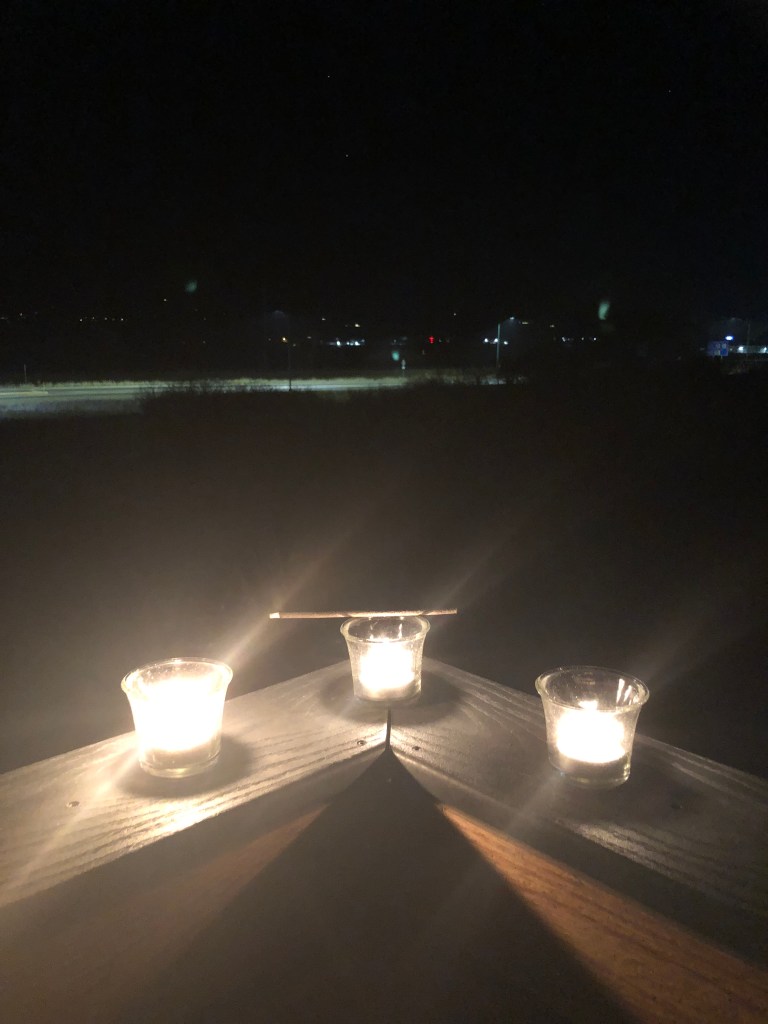
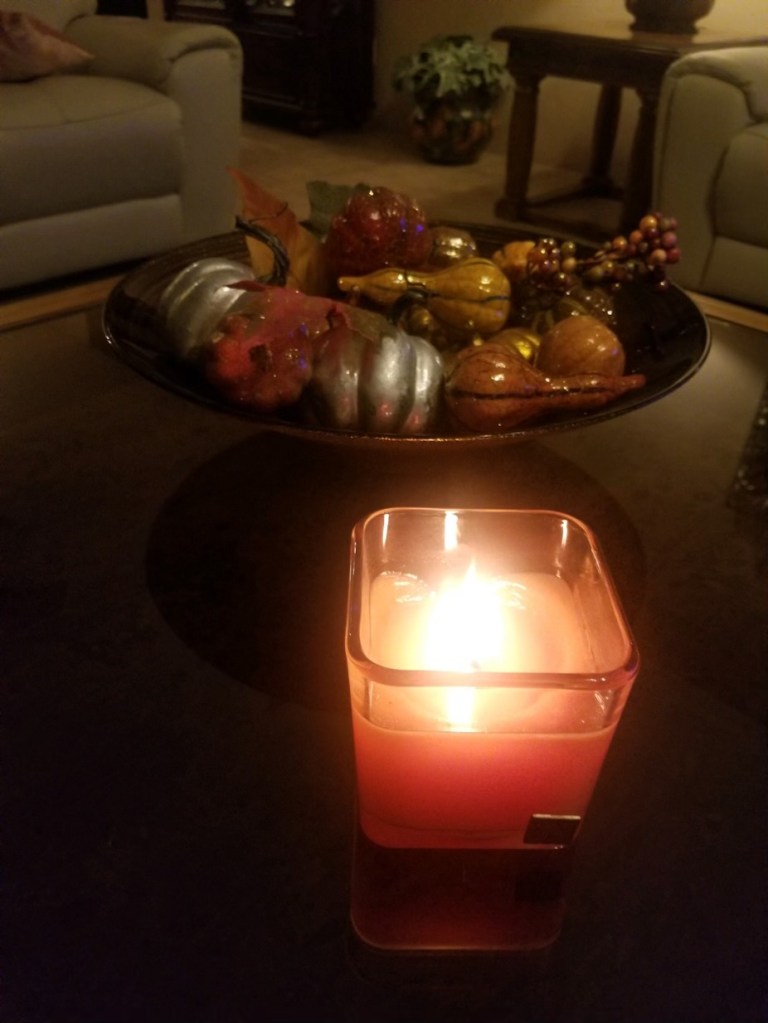
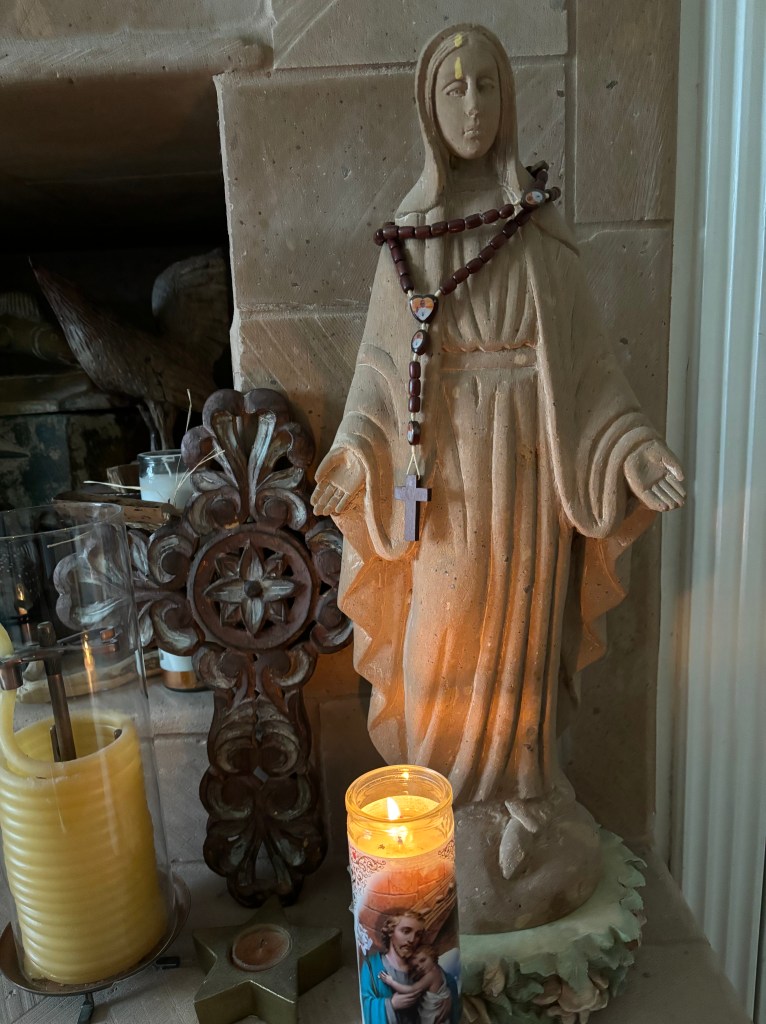
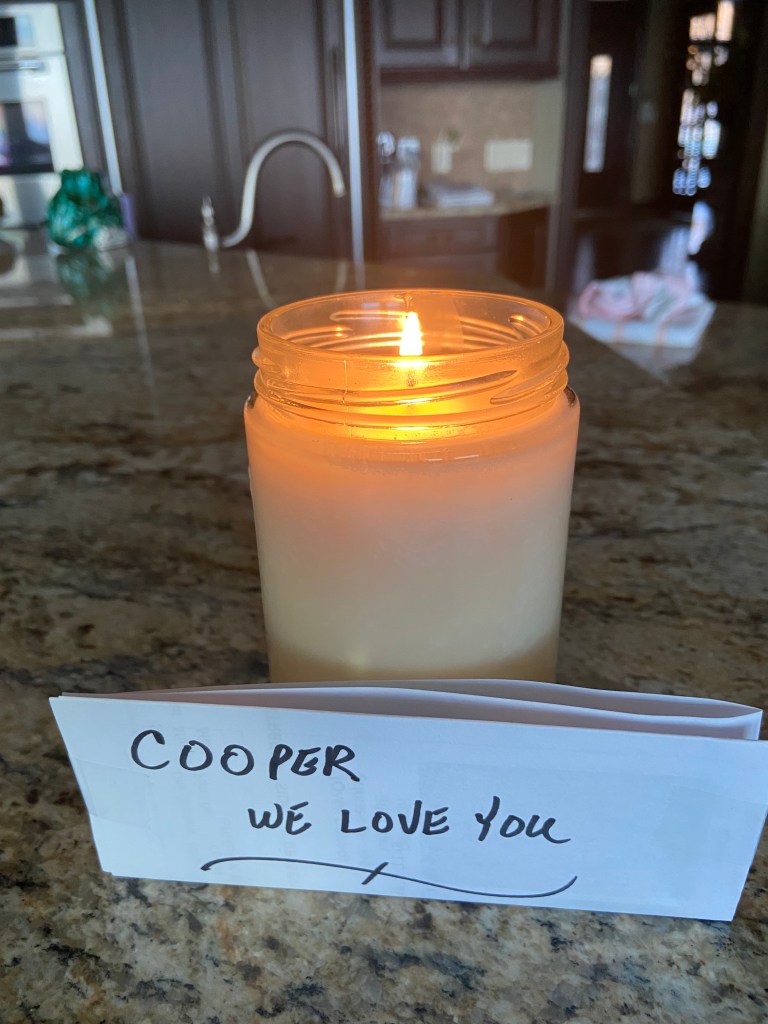
As I have shared, over the last 39 days, I have cracked the window in the house, left the light on, lit candles, and I have been offering prayers throughout the day for Cooper. I say his name, I talk about him, I remember the good times.
There is a group of women in Tubac, Arizona, family friends, whom my mom calls the “prayer warriors.” They have been praying for Cooper relentlessly.
Prayers for Cooper make a difference. Following the thread of my breath down to the bottom place, I believe this.
God is the breath in the breath.
In my prayers, I frequently ask the already departed—Cooper’s grandparents, family, and friends—to guide him and protect him, to show him the way home.
I reach out in prayer to my departed friends, a firefighter and a retired Marine, men who I know are battle-tested, and I ask them for their help in protecting and watching over my son in the Heavenly places. Because I know these men, and their hardwiring, I know that if they can, they will.
My prayer for Cooper, his soul, is rather simple; spiritual minimalism.
I pray for Cooper’s peace. It’s clear Cooper was not at peace. I want him to know peace down to the pinpoint atom center of his soul, and then infused throughout. Perfect bliss.
I pray for his happiness. A big, fat smile that never leaves. The face of his soul hurts because he can’t stop smiling.
I pray he knows and is surrounded by infinite love. The kind of love that makes you cry because it’s so overwhelming in its goodness.
I pray he is protected from the Harry Potter Dementors, and whatever the equivalent is del otro lado.
You must understand, I believe every person has an eternal soul that will never, ever die. When the soul separates from the physical body at death, it necessarily goes somewhere.
It’s why, when I was recently asked how many children I have, I answered four. I do have four children, one just happens to live in the spiritual realm these days. I will see Cooper again.
I believe Cooper, his soul, is with the Trinitarian God—that is, the Father, Son (Jesus), and Holy Spirit. I cannot prove this to you. Now you understand why it’s called “faith.” I am hoping and seeing, sensing, what is unseen.
But my (our) faith is not unreasoned and uninformed. I arrive at my faith partly through intellect, yes, but mainly through my heart, spirit, and will. I understand and accept my intellect has an upper limit where it no longer comprehends the spiritual dimensions.
In Cooper’s death, I am sensing with my heart. My daily prayer work arises from my spirit. This is not physical, intellectual, or emotional labor; this is spiritual labor.
I’ve never worked so hard.
Friends, as we approach day 40, I would like to ask for your help. Many of you have stated, “Please, let us know what you need, if you need anything at all…”
I accept your grace, and I ask for your prayers for Cooper’s soul today and tomorrow as we approach a spiritually significant cairn.
I am asking you to pray my simple prayer for Cooper, or please, pray your own prayers. Light a candle for Cooper, say his name, smile, remember him, tell good stories—he has some good ones.
I want to let the Universe know Cooper matters. I want to shake the foundations a bit.
Short Cooper Story
We educated all of our children in the primary grades at a local Montessori school. My wife and I have a great appreciation and fondness for all things Montessori.
One day, Cooper went to Montessori—this was in preschool or kindergarten—and the teacher noticed he was picking at his crotch all morning. He could not get comfortable.
The teacher took Cooper to the restroom to see what was going on. What was going on is that Cooper had heisted his brother’s Silly Putty and packed it in his underwear.
You can imagine a big wad of flattened Silly Putty sitting in Cooper’s underwear up against his stuff, and understand why he was picking at himself all morning.
My wife, the good mom and woman, is back to school teaching the littles. All things considered, she’s doing well. She’s crushed in the deep places, I know, and she will never be the same, but I’m really amazed at how well she’s navigating this tragic life event. She had her first counseling session yesterday and really liked her therapist. It went well.
I went for a walk today, part of my daily therapy, and decided against listening to audiobooks. Everybody’s preaching, and none of it is landing well with me. There’s too much noise, too many voices. I have to think about who I want to listen to. Narrow focus for me.
Instead, I decided to listen to Chris Stapleton’s new album, Higher.1 It’s an excellent album. Below are two songs that leveled me as I listened to the lyrics in relation to Cooper. Real tears.
I can’t help but to question my parenting following Cooper’s death.
What parent wouldn’t have questions, guilt, and a host of “what if we had done this, what if we had done that, what if we had zigged there instead of zagging?”
I understand that could have, would have, should have is normal in grief.
I am a student of resilience science. I have also been a teacher of resilience at the university. In my past studies, there’s a particular phrase I have come across that is ringing quite loudly in my mind: “good enough” parenting or caregiving (Dr. Michael Ungar).1
Resilience is rarely about an individual person and their personal grit. Grit matters little. Thirty years of international, cross-cultural research demonstrates convincingly that resilience is about the resources and support we have access to in our times of adversity and trauma—times like this.
For example, I am not “doing okay” right now because I have gritty personal qualities. I am doing okay, marginally, because I live in a comfortable house, in a safe community, and we have been supported by family, friends, coworkers, and a faith-wisdom leader. We are doing okay because we have access to counselors and have had time off work to process and begin to heal. We have health insurance. We have a car to drive to appointments. We have money to pay co-pays. We have coffee and craft beer. We have snacks and lots of chocolate.
For resilient outcomes, one “resource” we all need, which makes it easier to deal with tough times in life, is “good enough” parenting. To be clear, people do have resilient outcomes even if they didn’t (or don’t) have good enough parenting, but this likely means they have other resources that compensate.
As I think about Cooper and his upbringing, nurture and nature, how we raised him, and where we raised him, I can say, almost unequivocally, that our parenting of Cooper was “good enough.” You notice my lack of complete confidence. I notice it too. Writing “almost unequivocally” makes me chuckle to myself, and I suppose in this moment, I am glad to be laughing.
Here’s what I am expressing: I have guilt that my child took his own life. As I puzzle over why he did it, I can’t help but question my parenting. Where was I at play in his death? Where am I responsible and culpable? The old Episcopalian prayer comes to mind: “What have I done, and what have I left undone?”
As I think about resilience, resources, and Cooper, I do know with reasonable certainty that our parenting was “good enough.” I have a high level of confidence in this. Great parenting? Probably not. As all parents know, they don’t hand you a child-raising manual when you leave the hospital. You simply do the best you can at the time. Sadly, we tend to bring our own childhood dysfunction to the family dynamic, which makes great parenting difficult. And oh, by the way, who is the judge of great parenting? I like models. Show me a model of great parenting.
Now that I am thinking more clearly and have more space in my brain, I am beginning to read books on grief and healing following child loss. I didn’t get my first book purchase right for our particular situation, because it doesn’t deal with child loss per se, but I did enjoy reading The Deepest Place: Suffering and the Formation of Hope2 by Curt Thompson, MD.
I am very quickly learning, in the thick of the grief of child loss, that “resilience,” as I know it and teach it, is not enough. I am experiencing that there is another domain beyond resilience—meta-resilience—and it is hope. I now believe the formation of rugged hope is more important than resilience. Rugged hope, I think, is only born in the crucible of tremendous suffering.
When the micro-atomic bomb dropped on our house Sunday, October 8th, in the weeks following, it felt to me like the most important thing was to somehow sense, know, see, and feel there will be a better future. Otherwise, this is a f**king joke.
There will be better days, I know. My two boys, my daughter, and their bright futures are some things I am looking forward to. I am hopeful in figuring out our new future together with my wife following this devastation. We are not making any major changes for at least a year, but maybe we will go travel the world, who knows. I really want to visit Finland. Maybe we launch. Not saying we are going to do this; I am painting future possibilities to give us a glimpse of hope.
In his book, Dr. Thompson brings up secure attachment theory as necessary for forming hope, and he describes secure attachment through the 4 S’s: being Seen, Soothed, Safe, and Secure.
I think back to Cooper, especially his formative years, the last four years, the last year, even the last weeks of his life, and I ask myself: Was Cooper seen, soothed, safe, and secure in his relationship with his mother, father, brothers, sister, close family, and friends? Again, I believe with a high level of confidence, the answer is yes. Cooper was definitively seen, he was soothed, he was safe, and he was secure with his family and close friends.
Sadly, I don’t know if Cooper was seen, soothed, safe, and secure with others outside of the home. I would like to hope so.
Just know, every person we come into contact with on a given day could be in a very isolated and lonely place, very hurt, and our smile, our seeing them, may prevent further micro-atomic bombs being dropped on families.
On the Sunday morning Cooper took his life, my brother was in Florida on vacation with friends. When he learned about Cooper, he flew into town to be with us. He arrived late Sunday night. I honestly don’t know what I would have done without my brother here in those early days. He slept on the floor next to me all night for four nights, and we woke up throughout the night crying, talking, and sometimes standing up and hugging it out. My brother told his friends, “I need to leave and go walk through hell with my brother.” And he did. He stood in the center of the fire with me and did not shirk back. He left my house in tatters—it really was true hell.
One of the mornings, as we had coffee, my brother said, “Here are two things you need to know: 1) you loved your son and he loved you, and 2) you did the absolute best you could.” He was not asking me a question. He was making a statement; he was commanding me to hear him. As you can read, I did.
I have libertarian ethos tendencies. I do.
My great-grandfather was a miner and worked the copper mines in Butte, Montana. My grandfather was born in Butte. Growing up, my dad always said, “Live and let live.”
It was not until we lived in Montana for a few years that I was able to pick up on the underlying philosophy my dad was always preaching. Not unsurprisingly, I too share this philosophy. Live and let live.
Cooper was his own man, a created being in the image of God, imago dei, with his own eternal soul. He was the Captain of his ship, the master of his fate. As his father, I frequently counseled him, but I never forced him to do anything.
I counseled Cooper to “go pro” several times, to get professional counseling, and to see a doctor about getting baseline labs drawn. I gave Cooper a list of possible counselors and doctors to choose from, the ones covered by insurance, highly recommended he go see them, and then stood back. This goes back to the college days when he was having a tough go of it.
For some reason, it seems important for a lot of people around me to tell me that Cooper’s death is not my fault and that I shouldn’t feel guilty. I’m not a counselor nor trained in this profession, so they must have some reason for saying this to me.
What I have done here is share why I should not have guilt over Cooper taking his life. But again, if you have been reading my blog, I know my own tomfoolery, the tricks I am telling myself.
Friends, it’s okay; I accept, in the main, my own arguments here.
• Cooper surely had good enough parenting. I sincerely believe this.
• Cooper was seen, soothed, safe, and secure with his parents, siblings, and close family and friends.
• I loved my son, he loved me, and I did the absolute best I could in parenting him. My wife, the same. Brothers, the same. Sister, the same. Close family and friends, the same.
• I always treated Cooper as a unique, creative, intelligent, caring individual created in the image of God and capable of making his own choices. I nurtured his self-agency. I trusted his free will and did not impose myself upon him in a strict manner. I acted as mentor and confidant, especially as he grew older.
I believe all of the above, and it is true. But please, can you fault me (us) for having some level of guilt and remorse over this? This seems natural to me, to have these questions and guilt.
No matter. In my suffering, I do have hope for a brighter future. “The best days of my life are ahead of me.”
I pray the same for you. I am glad you exist, and I am excited for your future.
Ungar, Michael. Working with Children and Youth with Complex Needs: 2nd Edition. Oxford University Press, 2020. Resilience Research Centre, Dalhousie University. 52 Rugged and Resourced Protective Factors. www.resilienceresearch.org. ↩︎
Thompson, Curt. The Deepest Place: Suffering and the Formation of Hope. Zondervan, 2023. ↩︎
During my fire department career, I was not on a special operations team. These are the teams conducting specialized rescues, like swift water rescue, confined space rescue, and high-angle rescue. I did receive “operations” level training in these disciplines and later became a rope rescue technician.
After my fire department career in Arizona, we moved to Montana. I was a faculty member in the Fire Science program at Montana State University Billings. My wife was a 1st grade teacher in the public schools. Because tuition was low-cost for faculty, I decided to take a few courses I thought would be “fun.” They were fun; I loved them. I took courses in Search & Rescue, Wilderness First Responder, and Rock Climbing I. In Montana, these are next-level courses—they are legit.
With my educational background and experience in fire department leadership, I was also teaching a few leadership courses in the Outdoor Adventure Leadership program.
As I learned more about search and rescue in the backcountry, I applied and interviewed to become a Volunteer Search & Rescue Technician with a Fire/Rescue Department near the Beartooth Mountains. I was accepted and began training. I did not finish the volunteer training program before moving to the Midwest, but I was able to complete some excellent search and rescue training, including avalanche rescue training.
I share the above to highlight a sociological theory called “edgework,” and how I have been thinking about this concept in the last few days as I continue to process my grief, sadness, and sorrow following Cooper’s death. I am not steeped in the theory of edgework; I only know it as a concept. As my Israeli friend, Eitan, says, “Let’s not let details ruin a good story, shall we?”
Edgework was originally applied to thrill-seekers pushing their physical limits right up to the edge of life and death. When you watch a Warren Miller ski film or big wave surfers, this is edgework in the physical realm. This was the original intent of the language. The rush of thrill-seekers is held right on the edge of life and death.
Jen Lois, a search and rescue technician in Colorado and researcher, began to apply this term to the emotional dynamics that search and rescue technicians experience in their work.1 She moved the meaning away from physicality and toward the mental and emotional realm. She wondered how rescuers bring their emotions and minds to the upper limits of functioning under extreme stress in backcountry rescue2.
Good rescuers need to be in mental and emotional control. They need to know their limits and recognize when they are nearing them. A rescuer beyond their upper limits serves nobody well; they become a liability and may even need rescuing, creating a greater problem—an unfortunate cascade.
Good rescuers are not thrill-seekers. This is not unlike firefighting. I never considered myself a thrill-seeker during my fire department career; quite the opposite, actually. I—we—took a very calculated approach to saving lives. There were a few times when my work took me to the edge—physically, mentally, and emotionally. In fact, upon my retirement after 25 years of service, I experienced being mentally and emotionally over the edge, and it took me a good eight months to right myself. Stress injury is for real.
In the immediate aftermath of Cooper’s death, one of my initial responses was to want to chase after him into the spirit realms. No, I did not want to end my life. I have always enjoyed living, and I still do today. It was my hardwiring as a firefighter coming out—I wanted to attempt a rescue, spiritually. If there was a thin space I could jump into and do battle with the spirits to bring Cooper back, I was willing. I was willing to fight a spiritual fire, if only I could.
Further, I did not want my son going it alone. I was trafficking in the maxim from Backdraft, the firefighting movie: “If you go, we go.” It pained me—it still pains me—that Cooper left this world alone. I know, I know. People tell me he was not alone, the Heavenlies were with him. I pray it so, but nevertheless, there was not another person in the flesh and blood with him. This greatly bothers me.
Of course, we live in reality, and there is no unwinding the clock. What is done is done. While I cannot unwind the clock, I have gone back in my spiritual imagination and prayed for Cooper in that moment, imagining I was with him. Call it holy mysticism. Yes, I know he’s still going to do his thing, and I can’t stop him, but in this spiritual imagining, he’s not alone; I am holding his hand. I don’t try to stop him, I am simply with him. This idea, of praying back in time to be with Cooper in that moment, came through a counselor with Red Bird Ministries.3 I recently had a “comfort call” with her, and she presented this idea as we were talking. It resonated with me.
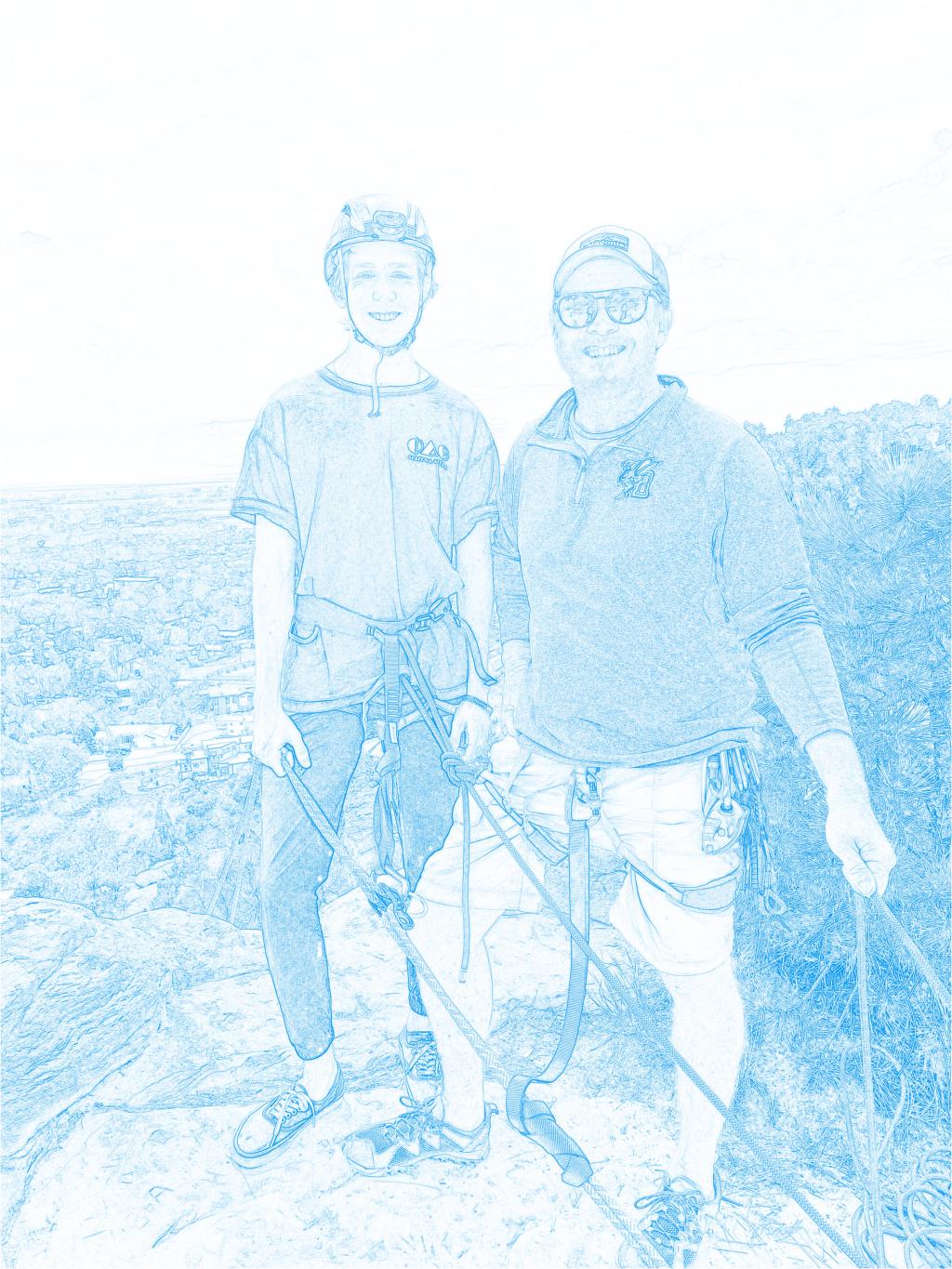
For today, and the last few weeks, I feel like what I have been doing is spiritual edgework. I keep coming back to a memory I have of setting up an anchoring system for rock climbing and rappelling. I am standing right on the edge of rock, anchored in, with Cooper. He’s getting ready to rappel. We are safe, but not entirely without risk. I am not alone. We are standing together on the edge. It’s a great day. We are together—no cell phones. Just a father, his son, and their hands, in nature, sun on the skin.
I know, because I am living it, any person who has lost someone special to them due to unexpected loss, especially suicide, is doing edgework every day in the immediate aftermath of their loss. It’s precarious spiritual space to be in.
We are standing on a spiritual edge, hopefully anchored in, hopefully not alone, peeking over into the abyss wondering what’s on the other side of this thin space, where did our loved one go, and why?
We might say, “God, Universe, Creator, I am not angry, but please, do tell.” We might add, “I may, in the future, be angry, and You will surely know, but for today, I am vexed.”
I made a comment in my last post about standing together as a noble act. I believe this.
I think it’s interesting that standing, feet shoulder-width apart, with a firm feeling of being grounded, together with others who I know care, on the edge of a cliff, is the image I have during this phase of grief.
I know I am doing spiritual edgework, poking around in spiritual areas. Some of these areas feel comfortable; others feel tenuous. As I noted, part of being a good “rescuer” is knowing your limits and stepping back from the edge. I have done this on a few occasions.
I am not thrill-seeking. I am meaning-making—trying.
The truth is, I know I am never really going to know for sure why Cooper took his own life. As I have read through Cooper’s accessible data (that I have been able to gain access to), I have gained a fuller, though not a complete, picture. What I have is a charcoal sketch, rough in the outline. I am feeling some level of contentment with this. One, I love charcoal sketches. But two, I feel I have done the due diligence I will be able to do with this chapter of the Unfolding.
What I most miss in this exploration of the spiritual edge, besides being with my son, is a faith-wisdom community—more anchors. Given the vicissitudes of life—COVID-19, moving to a new town—we have not yet established a faith-wisdom community to grow and worship with, to explore with. I am greatly sensing this gap in our life right now. This is an area I (we) need to shore up—mental note to self; and, no pun intended for the rescue audience.
How am I doing? I think okay. I have been doing spiritual edgework, I have not been alone, I am anchored in, and I have a healthy respect for my spiritual limits, including mental and emotional limits. My feet are shoulder-width apart, I am grounded, but I have been on the edge. I am comfortable here, peering over, wondering “where’s Cooper?”
I pray you are doing well. Safe edge-working to you. Let me know if you need an anchor. I am here for you too.
Lois, Jennifer. Heroic Efforts: The Emotional Culture of Search and Rescue Volunteers. NYU Press, 2003. ↩︎
The flowers have mostly run their course. A few bouquets, late in coming, are still alive with color but are beginning to wilt. The food is eaten, and various snacks litter the kitchen counter—even in grief, there are limits to how many snacks one can eat in good conscience.
The beautiful, heartfelt cards have slowed in arriving. Text messages are scant, and the emails are gone too. My phone rings less. I frequently talk with my wife, daughter, and mom—a little less so with my brother—and I stay in touch with our sons living out of state. They are not big talkers.
I knew this day would come, but the silence—the “bounce,” as my neighbor describes it—arrived more quickly than I anticipated. Most family and friends want to get on with their lives, regain their own balance, and move forward. This is completely understandable; I would too.
Understand, we (my wife and I) can’t move forward that fast. To be fair, I am okay with this period of relative silence. I need the time and space to process, reflect, and grieve. It’s important to me, in honor of my son, that I make as much sense of this as I can. I am spending a lot of time going through Cooper’s digital history, looking for clues, trying to make sense of things. In fact, there are some things coming up that, while hard, are filling in the gaps.
My wife is home; she has been off work from teaching her “littles,” as have I, and we spend a lot of time together talking and reflecting. We tend to end up talking in circles sometimes, but I think this is okay. We are processing together. While I am weepy in the morning, my wife is weepy in the evening. We are working through our grief in different ways and at different speeds. I need to make sense of this, while my wife spends time looking at pictures and feeling. I create timelines and read through texts and emails; my wife sends pictures for printing at Walgreens.
I am still shocked by how suddenly Cooper vanished. He was here one moment and gone the next. I had a hamburger and a beer with him Saturday at a tailgate party, and then Sunday morning, he was gone. As I previously wrote, the finality of losing him is crushing. Man, it hurts. It hurts me too because I know, I believe, with quality therapy and good medical care there more than likely would have been a different outcome.
Friends ask, “How are you doing?” In truth, I think I am doing okay. I am being sincere. As I respond to this question when it’s asked, I wonder: what’s the barometer for losing a child, the gauge, to know how you are really doing? What is my basis of comparison? While I think I am doing “okay,” I have no past life experience to draw from, comparable with this event. None of my life experiences can begin to compare with this enormous blow.
Friends, I will explore counseling or grief therapy; I am not against it. My wife has already scheduled a meeting with a counselor. She’s on it, and I applaud her. I am still “feeling”—not thinking—about how I want to process this loss in the manner best for me.
Some days, I just feel like getting in the car and driving for a long, long time. A road trip. Road trips allow for that quiet processing time, just thinking it through.
Sure, I have had hard times in my life. I wonder if hard time x 1, plus hard time x 2, plus hard time x 3 creates an ability to deal with hard times no matter the context? I mean to say, I have had some steeling in my life, and I think this has helped me.
I am walking 30 minutes per day, eating decent food in reasonable amounts, drinking water, sleeping reasonably well, reading, praying, and otherwise caring for myself and my family. My wife is doing the same. Oddly, I do find that I am drinking coffee throughout the entire day—this is new for me. It seems I have to have something in my hand.
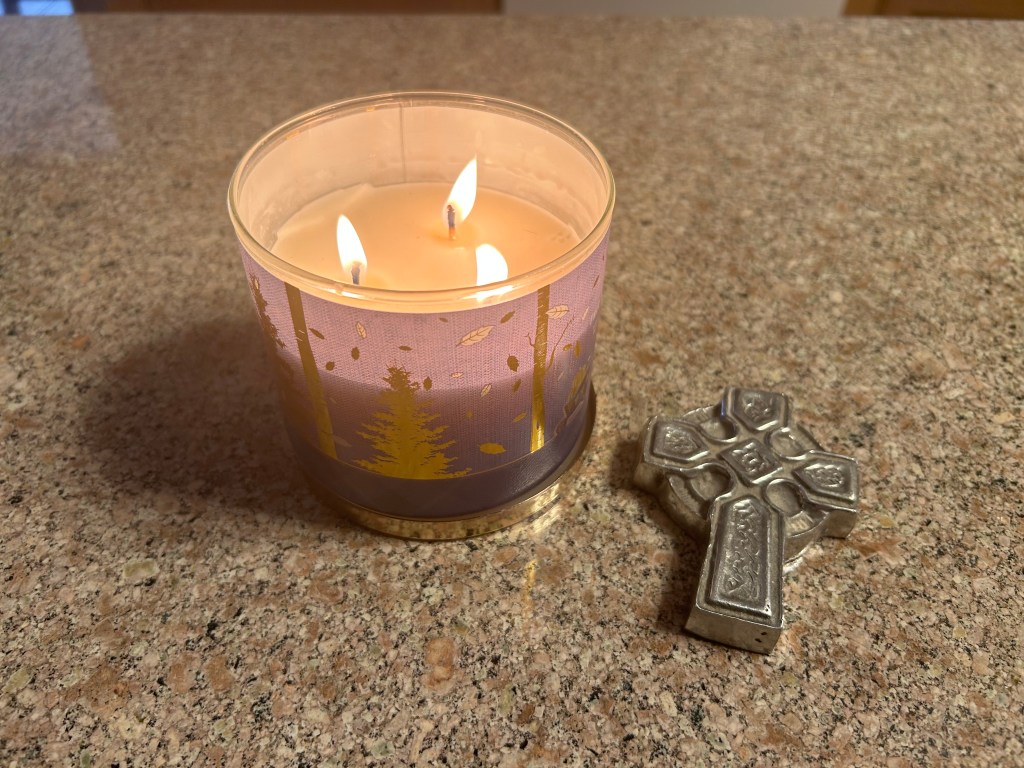
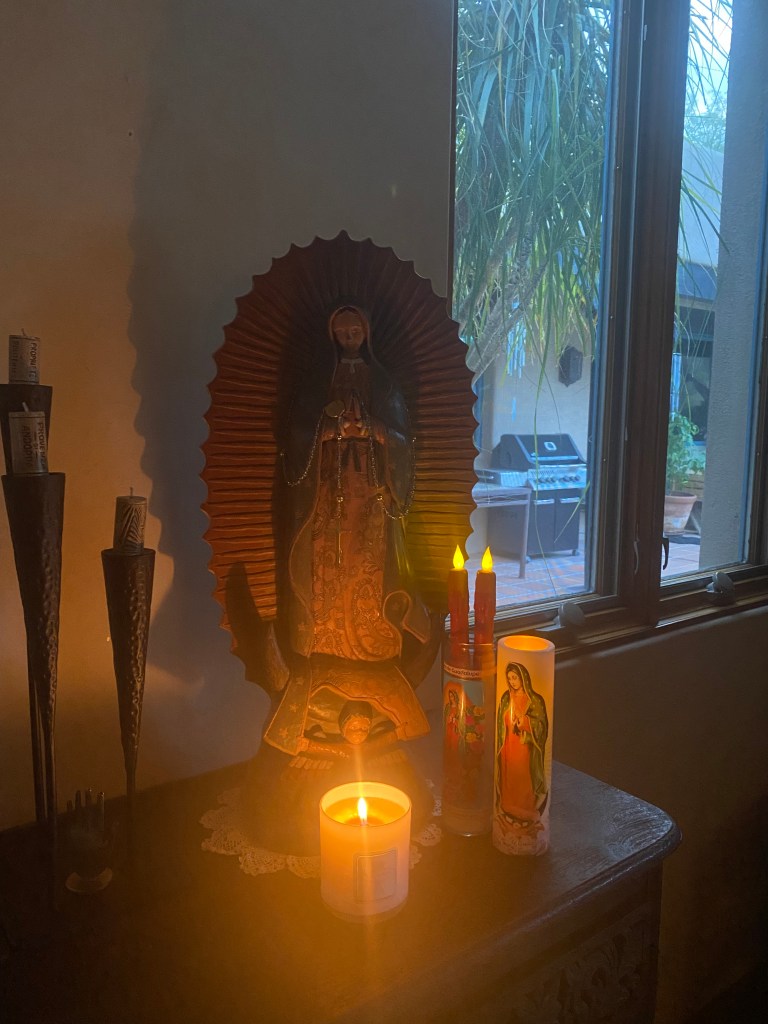
I have a morning routine. I get up, take the dogs out, pick up the house a bit, and start the coffee. I am still cracking the window and turning the lights on in Cooper’s room, you know, so his soul can visit. I light a candle and say my prayers for Cooper and for all of our family and friends, for healing in this grief.
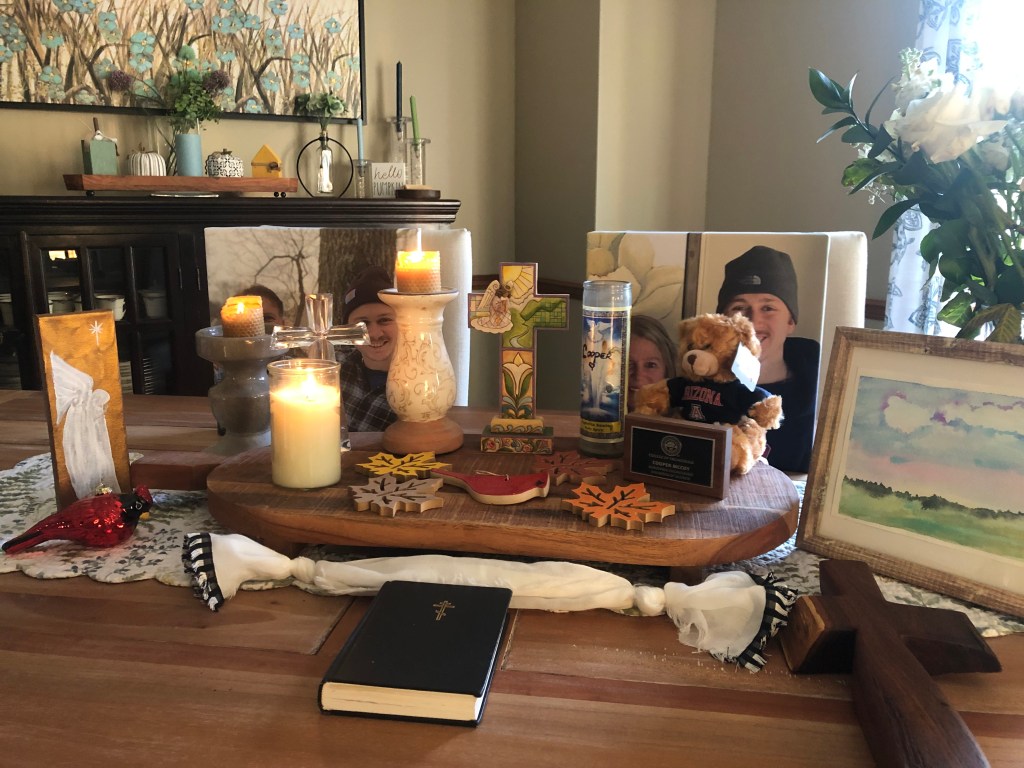
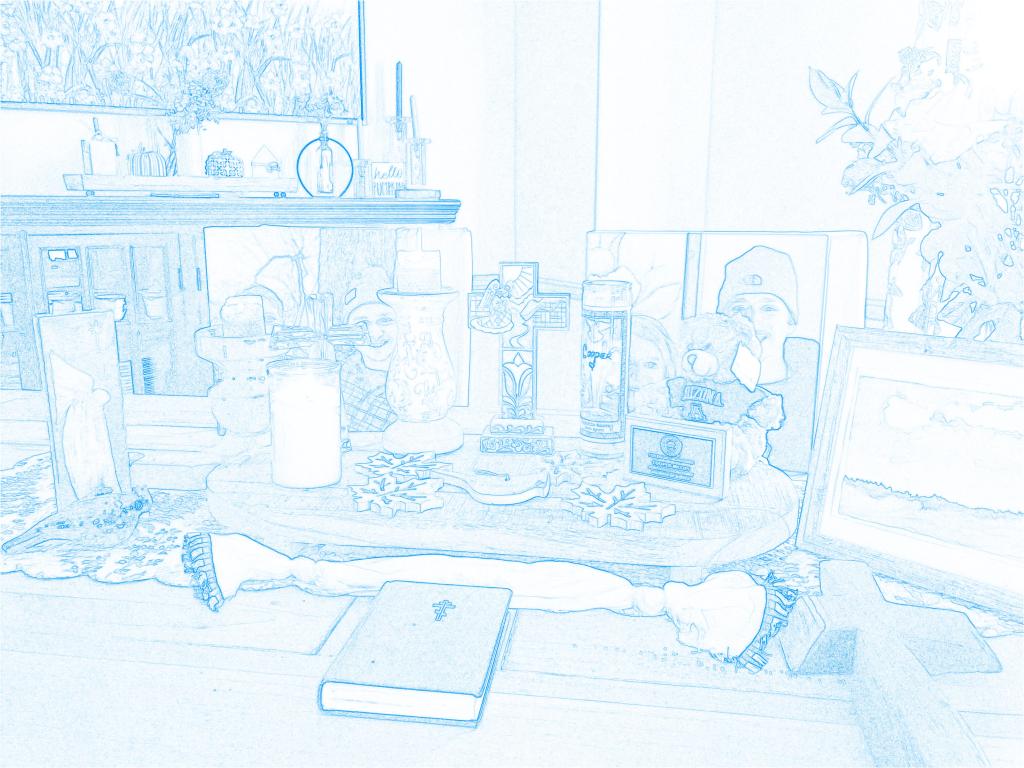
Alter on dining room table
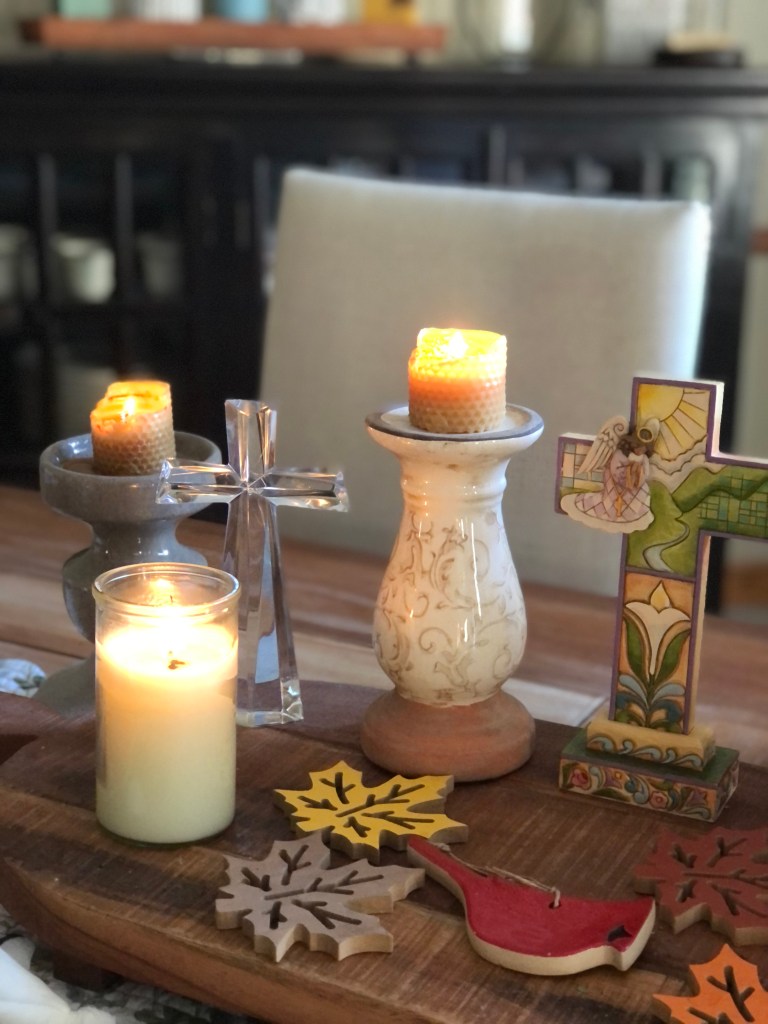
Our long, wooden dining room table has become an altar. Pictures of Cooper, crosses, ceramic cardinals, watercolor paintings, angels, candles, the Bible, and flowers cover the table. This is where I say my morning prayers, after lighting the candle for the day.
I am functioning, but I do notice I have a diminished capacity for sustained cognitive activity and remembering. I can’t work through mental complexity as I normally would. My usually poor listening skills are at an all-time low. What?
My emotions come in waves, and they are difficult to name. I am not sure how to describe these emotions showing up in my body. I am dealing with feelings I have never had before.
On some days, I feel good. I have hope for a brighter future in the midst of this suffering. I know there is a positive future ahead of me. I say a new mantra out loud to myself, “The best days of my life are ahead of me.” I know I am sort of lying to myself in saying this, but my brain is pretty naive. It believes the things I tell it, funnily, even when it knows it is being deceived.
In some moments, on given days, I do realize with absolute clarity what a huge, life-shattering event this really is, and I can’t even hide it from myself. The magnitude of losing my son hits me hard, and I weep in my grief. I loved him, I miss him, and I am heartbroken that he was in so much pain and I did not know the depth of it. He was such a good soul with such a bright future ahead of him.
I know this sudden, tragic event has impacted many, many people—friends and family. We, as parents, are not the only ones grieving. All of us are. We all hurt, and I know this.
Here we are then, standing together. And I think, if I didn’t know any better, that for today, standing together is a noble act.
Together, as a family, we made the decision to bury Cooper. He was laid to rest next to his grandfather, Poppy Jack, and his great-grandparents, on October 20th.
Victoria and I purchased two plots next to Cooper’s, and someday, we will be buried next to our son. When we next visit the cemetery, I will get the latitude and longitude coordinates and send them. If any of Cooper’s friends or family decide to take a road trip, let us know, and you can stay with us. The cemetery is 1.5 hours from our home.
The funeral∗ was a small graveside service with immediate family present. I delivered the service. I aimed for a Christian, experiential, affective service. An invocation for God to be with us was made. Family members were anointed with oil for healing. We read Psalm 23 together: “Yea, though I walk through the valley of the shadow of death, I will fear no evil; for You are with me; Your rod and Your staff, they comfort me.” We borrowed from the Quaker tradition and spent time in silence. Cooper was eulogized. The gravesite was blessed with holy water. We circled the casket, holding hands, and prayed the Lord’s Prayer together. Each of us placed a handful of dirt on top of the casket, symbolizing ashes to ashes, dust to dust. The song “Memorial” by Ike Ndolo was played.
We can’t say why exactly we chose burial over cremation. As we joked, ‘the little man inside us’ (Seinfeld) was simply telling us it was more appropriate for our family to bury Cooper. So we followed that still, small voice.
We didn’t do embalming, no vault, and we opted for a biodegradable casket. We imagine years from now, Cooper will quite literally become the grass, the trees, the insects, and the birds of the air. The full circle of life, playing out on a little hill, on a prairie, in the Midwest—with the blades of grass waving their prayers and the bugs reflecting the sunlight as it slices through the trees.
Before Cooper was buried, we took Snoopy, his dog, to see him. Snoopy sniffed a lot, placed his paw on Cooper’s arm, but didn’t seem distraught. We just wanted Snoopy to know that Cooper wasn’t coming home. We had one last chance to anoint Cooper’s body with olive oil, frankincense, rosemary, and cinnamon.
We are learning that trying times bring out the weird. We talk to Cooper as if he’s still with us, sit in his living room, touch his guitar, books, and wallet. We smell the room like we’re drawing him in. We light candles every morning, crack the back door so his soul can enter, and so on. We imagine this is normal?
The first week was a traumatic madhouse. Our foundation gave way. Things have calmed down; we’re doing better. Today is the second day all family has been gone—now it’s me, Victoria, Grace, and Grandma Lois. It’s obvious Cooper is missing; the void is palpable. We stand at the window with long, blank stares, barely noticing the trees changing colors and the leaves falling.
Did the change of seasons factor into this?
I remember hiking in the mountains once. I sat in a beautiful clearing and wanted my life to look like that—beautiful. Shortly up the hill, I came across a mangled gulley where water and lightning had left a mess. I stood there for a long time before I could see it, but I finally did. Despite the devastation, there was life—moss, bugs, birds, new growth.
Already, we’ve seen beauty in this tragedy. Our family, friends, and coworkers (especially from my wife’s local school community) have shown us great love and care. Your condolences, wonderful food, flowers, cards, art, candles, and the general compassion you’ve shown us have held us up when it’s been difficult to stand or function on our own. For this, we are grateful.
We write this letter in deep, aching soul pain. Our youngest son, Cooper James, 23, took his own life in the early morning of Sunday, October 8th near a local conservation area.
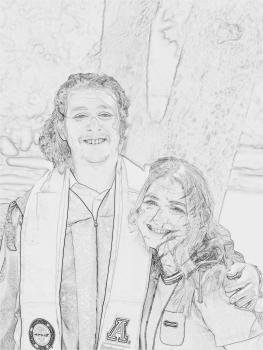
Cooper grew up in Southern Arizona, playing club and high school soccer. He graduated high school from high school and attended university. He majored in Aerospace Engineering and graduated May 2022. Shortly after graduation, Cooper was hired by a university in the Midwest.
Cooper moved to the Midwest and was living at home with us over the last year, learning his new job and saving money.
For those who knew Cooper well, you know he was a sweet, gentle soul. Everybody, to a person, loved Cooper. He was pleasant and easy to be around.
Cooper was an animal lover, and in particular, he loved our family dogs- Snoopy, Bear Bear, and Willow. Snoopy, 13, was Cooper’s dog. Cooper also had a weird thing for hedgehogs, he loved them.
Cooper’s closest friend growing up was Ethan. If we didn’t know any better, we would say that Ethan’s family had a third son for many years.
Cooper wore a Hebrew bracelet throughout his college days which translates roughly as, “a man is a man is a man.” Meaning, we’re all humans in the end.
Living at home with us, Cooper was able to spend a year of quality time with his grandfather, Poppy Jack, before his death from Parkinson’s disease May 2023. Poppy Jack beamed with pride Cooper worked at his alma matter.
Cooper was actively flying Cessna airplanes and close to securing his private pilot’s license. He recently made a cross country flight, his first.
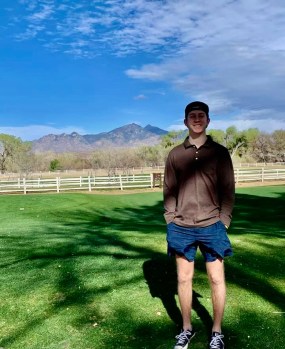
Cooper golfed on the weekends, spent time at the lake and conservation areas hiking, and drove around in his new Honda Civic checking out the sites. Cooper enjoyed living in a college town and he spent time on college boulevard eating, drinking, and hanging out.
Over the last year, Cooper began lifting weights religiously and he was big and strong. Cooper was teaching himself how to play the guitar, he was getting good at it, and he was taking French lessons one night per week. As Cooper lived with us, we noticed structure and routine were important to him.
We don’t know why Cooper took his life. We can look back and see a few red flags, but nothing glaring. We have many unanswered questions, and tremendous guilt. While we don’t know why Cooper took his life, we are beginning to shape some contours that feel like this:
Cooper was not using drugs and he did not drink often. Cooper was a gentle, sensitive soul living in a harsh world. Cooper was hard on himself, a perfectionist who applied perfectionism to himself. College was especially hard on Cooper. He was in an advanced degree program and the stress of the program took a toll on him. While he was brilliant, and I mean this literally (his IQ was high), he was also socially introverted. This social introversion made it difficult for Cooper to make new friends and develop intimate relationships- from his perspective. This social introversion led to feelings of loneliness and isolation. Two years of COVID-19 messaging, “socially distance and isolate,” during Cooper’s last two years of college did not help him, and it compounded his feelings of loneliness and isolation. Layered into all of this is undiagnosed depression (likely) and generalized anxiety on top of social anxiety. This created a heavy load. Cooper was in a lot of pain and he went longer than I believe any of us could have. He endured a lot.
We don’t know if the above initial sketch is “correct” or not, and we will never know for sure, but it’s all we have right now, it’s the best we can come up with. As parents drowning in grief, we are naturally seeking answers.
We long and ache to know what happened, but more than anything, we want a do over, a chance to get it right. The finality of this event is crushing and the pain immense. It doesn’t seem like it was supposed to happen, we feel like the Universe got it wrong. We want our son back.
As we look back at pictures of Cooper over the years, it is clear to us that Cooper did have a good life, with many good times and memories made with family and friends. We see his smile, a twinkle in his eye, a gentle smirk, and genuine happiness.
We did a short Memorial Service for Cooper at our house on October 12th, with close family present. It was stunningly beautiful and perfect and brought a sense of peace to our house. We later visited Cooper at the funeral home and spent time with his body, honoring him, touching him, and saying goodbye. It was the kind of experience that sucks the air from your lungs and drops you to your knees, but so necessary in our healing process. Cooper’s brothers, CH and Carse, his sister, Grace, sister-in-law, Em, grandmothers, Lois and Kathy, grandpa, James, were with us. We left Snoopy’s dog collar in his hands. We prayed deeply for him and over him.
So where do we go from here?
We are not sure if we are cremating or burying Cooper. Oddly, it’s a tough decision because we never put thought into this. If buried, Cooper will be buried next to his grandfather, Jack, and his great grandparents. In this instance, we will buy plots next to his and be buried with him in the future.
Many have asked us how they can help or where they can donate. Given Cooper’s love and fondness for animals, especially dogs, we ask family and friends to donate in memory of Cooper James to your local animal shelter or humane society. Most animal shelters are reputable 501(c)(3) and donations are tax deductible.
We clearly have a long, painful road of grief and recovery ahead of us. Our family will never be the same. How could it?
The best thing you can do for us right now is hold Cooper’s loving memory with you always. Keep his gentle light alive in your heart. Say his name, remember him, smile for him. Pray for him, and pray for us.
We need to end the stigma surrounding mental health and wellness. There is no shame in seeking counseling and establishing baseline medical care (labs) with your family doctor. Sadly, self harm is endemic in our society and we are not doing enough to help our young men.
Finally, in case you didn’t know, the US has a relatively new 9-8-8 suicide and crisis hotline for mental health emergencies. Learn the number, know it, and share it.











 Endure