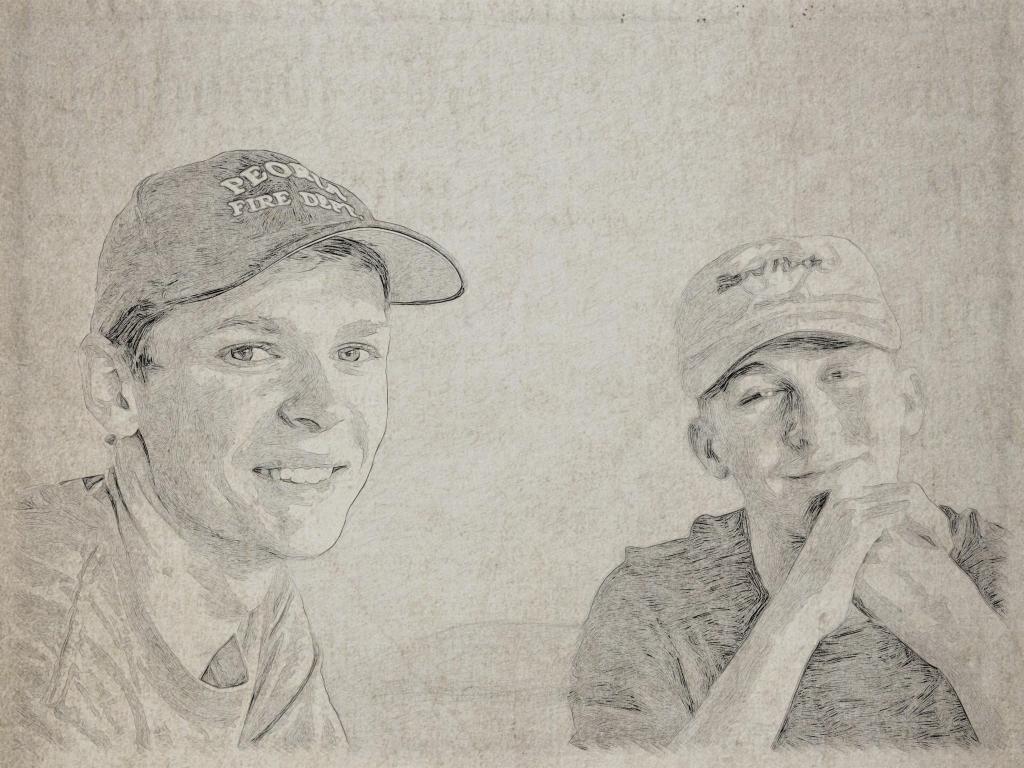
Chapter 1
I don’t know why, but I’ve always imagined my life unfolding in three narrative arcs—three overlapping yet distinct phases. If my life’s a story, there are three chapters.
Inshallah.
My first chapter was physical, the second intellectual, and the third, I intend, will be spiritual.
In my estimation, the first phase of my life is complete. I worked a fire department career, and I chalk this up to the physical phase.
Don’t get me wrong, firefighters are incredibly smart people. Matthew B. Crawford, author of Shop Class as Soul Craft,1 argues for the intelligence of those who work in the trades.
It’s why Maria Montessori’s method is brilliant. If all knowledge is derived through the senses—and I believe it is—then it stands to reason that those who work with their hands, interacting with objective reality, are intelligent.
Meaning to say, firefighters, plumbers, electricians, and so on are intelligent people because they learn about the world through their senses.
Also, firefighting is spiritual work. When I broke bread with my brothers at the kitchen table for lunch, dinner, and morning coffee each and every shift, I was partaking in something like a Eucharist.
Nevertheless, firefighting is physically demanding, and I consider the chapter of my life lived in the physical arc as complete.
Chapter 2
After I retired from the fire service, I transitioned to work in higher education—teaching. I think of teaching as aligned with the intellect, though I’m not dismissing the spiritual and relational aspects of it. Certainly, there is a spiritual component to teaching, at least when it’s done well.
These imagined chapters of my life do have overlap. I’m sharing a construct, a heuristic that has given my life shape, a trajectory to follow.
Incidentally, I think this lack of shape and trajectory is part of what’s hurting young men, causing them to despair. So many young men lack a sense of purpose and cohesion in their lives. Knowing your “why” is important. Or knowing the general outline of your arc(s) is important.
In the months before Cooper’s death (BCD), I felt my intellect was on fire. My brain seemed to be working well. I was taking a class through the University of Helsinki to learn the Finnish language, enrolled in a Christian master’s degree program, and gearing up to take a weeklong course at the Massachusetts Institute of Technology.
And then, bam!
I am thankful I read Shattered: Surviving the Loss of a Child2 in the early days after Cooper’s death (ACD). It helped me understand that my life had forever changed and that there would be mental and intellectual impacts.
Indeed, there have been.
While I’ve recovered some of my intellectual functioning, I am not where I left off. Maybe I never will be, and that’s okay. My brother says it will probably take a year or two. I think he’s right.
My wife and I recently watched the Netflix movie, Good Grief. It was the trailer that lured me in. In the first twenty seconds of the trailer, the main character, Marc (played by Dan Levy), says:
“I’ve been reading that the brain is like a muscle. It’s why getting over a death is so hard. Because your brain has been trained to feel things for a person, when they go away your head is still operating under the impression that it should feel those things for that person, like muscle memory.” — Good Grief, Trailer
When I saw this trailer, I had to watch the movie. This 20-second soundbite resonated deeply with me. Yes, this makes sense to me. My brain is still operating, in some sense, as if Cooper is here, but he’s not. My brain is lagging behind reality; it’s been “trained” to love him, think of him, feel for him, call him, text him, converse with him, etc.
How long does it take to unwind 23 years of unconditional conditioning?
Another thing, I recently read an article on grief that popped up in my Facebook feed. It’s written by Marie Peltonen, discussing research on grief by Astrid Swan at the University of Helsinki.
Marie writes:
“In the past few decades, research on grief in the fields of psychology and neuroscience has produced fresh insights on the topic. For example, functional magnetic resonance imaging (fMRI) has demonstrated that the same brain regions are activated when grieving as when navigating to a destination.
In concrete terms, grief can thus be described as the presumed route to a loved one ceasing to exist. At the same time, coping with grief has become medicalized, and the focus on overcoming grief may result in harmful expectations.” —Marie Peltonen, University of Helsinki3
I’ve read three books on grief following Cooper’s death, and these few sentences alone make more sense to me than all the material in the books.
I am trying to navigate to a destination: Cooper. My son is “lost” (or I am lost), and I am trying to find a route to him, but he no longer exists in this world. While I know Cooper is not here, my brain, out of muscle memory, is still operating as if.
This, I think, is grief—trying to navigate to a destination (a loved one) out of mental habit, training, and years of conditioning, to a destination (a loved one) that is no longer there.
Notwithstanding the routing problems, I simply miss my boy.
Finally, the last part of that quote is worth reflecting upon: “Coping with grief has become medicalized, and the focus on overcoming grief may result in harmful expectations.”
There’s a reason mountaintop villages have shamans. There’s a reason people hole up and drink yak’s milk with the Nepalese.
I’m stuck in chapter 2. Or maybe chapter 2 has a poor ending, and it’s on to chapter 3 sooner than I anticipated…
Chapter 3
?
- Crawford, Matthew B. Shop Class as Soulcraft: An Inquiry into the Value of Work. Penguin Books, 2009. ↩︎
- Roe, Gary. Shattered: Surviving the Loss of a Child. Grief.com, https://grief.com/books-on-the-loss-of-a-child/shattered-surviving-loss-child-gary-roe/ ↩︎
- “Grief in Dying Often Goes Unacknowledged.” University of Helsinki, 11 Jan. 2018, www.helsinki.fi/en/news/culture/grief-dying-often-goes-unacknowledged. Accessed 25 Sept. 2024. ↩︎
 Endure
Leave a comment