I grew up in Arizona, solidly middle class. Or maybe we were lower middle class, and I have more lofty memories than I ought to have. I’m not sure. I snow skied and slam danced. You tell me.
All things considered, our middle-class neighborhood was culturally diverse. My best friend throughout high school was South Korean. His mother was South Korean by birth, and his father was American. My friend’s grandmother, directly from South Korea, lived with his family. It was three generations living together under one roof.
“Grandma” is pronounced “Halmeoni” in Korean. This is what we called my friend’s grandmother, Halmeoni. Halmeoni spoke no English. None. Despite this, Halmeoni took on a grandmotherly role for me. When I visited my friend, which was often (he lived around the corner), Halmeoni always wanted to see my hands. She would look at my palms, rub them, and look up at me with her little old round face and smile warmly. I don’t know if she was reading my palms, but I always assumed it was something like that. My friend never told me what she was doing; maybe he didn’t know.

Halmeoni gave me a good feeling about my future. There was nothing in her smile that indicated an easy life, but I’ve always imagined a full and robust life based on what I read in her expressions while she was peering into my palms, or whatever it was she was doing.
I’m told that years later, on her deathbed, Halmeoni said my name, “Kelly.” She said it a few times. I miss Halmeoni. She was a good grandmother to me.
Fast forward a few years. I am a young man now, a firefighter, and I am married with three small children—all boys at this point. Little Miss Sunshine (Grace), our daughter, was still just a twinkle in our eyes. We bought a house in a master-planned community in a cul-de-sac. Yes, I was still rolling solidly middle class. Or, you know, I am recalling life more loftily than I ought.
There were seven homes in the cul-de-sac. If you’re into numbers, it’s not a bad set.
Our immediate neighbors to the south were Orthodox Christians from Assyria. They fled their home country under extreme persecution. We immediately hit it off with this family. In fact, they called us family. They said, “If we have a problem and need help, our family, who lives many miles away, cannot help us. But you, you can help us. Therefore, you are now our family.” It was a simple logic that made sense to me. Like my friend growing up, there were three generations living in this home. I had, once again, another grandma and grandpa. Grandpa Otto always wanted to shake my hand and stand in front of me, holding our handshake and smiling. This was our greeting. Like Halmeoni, my new grandparents spoke no English. We spent a lot of time with our neighbors eating and drinking, and the kids played together safely in the cul-de-sac.
Across the street in the cul-de-sac was a large Hispanic family. This family also had three generations living under one roof. The grandparents spoke little English. We were friends with this family and spent a lot of time in the cul-de-sac, drinking and smoking hookah with raspberry tobacco, courtesy of our Assyrian family. Their children were older, so our kids didn’t spend as much time together.
These three families, in addition to our many Hispanic/Mexican family and friends, have influenced how I think about multigenerational living. They modeled it very well.
I’ve thought a lot about these families over the years. They were comfortable with their older children and parents living at home, perhaps indefinitely, under one roof. I’ve mentally compared and contrasted my observations of these families with white families. In white culture, which I am a part of, it’s frowned upon for grown children to live at home. Grandparents rarely live at home; they are sent to nursing homes.
As I have labored in the workforce for many years and become a middle-aged man, I know how difficult it is to earn a living, support a family, build a life, and gain upward mobility. It’s increasingly challenging to gain a foothold in life as a young person—even with a college degree and help from family.
By the time Cooper graduated from college in May 2022, we had moved to the Midwest to help care for my father-in-law. This left Cooper a few choices: 1) live with grandma and grandpa in Southern Arizona while job hunting, 2) live with mom and dad in the Midwest while job hunting, or 3) live with friends or brothers while job hunting. The bottom line was that we were no longer paying Cooper’s rent.

As it happened, Cooper landed a job at the university and moved from Southern Arizona to the Midwest, moving in with us. It was a quick, seamless, and smooth transition.
Serendipitously, I had spent the previous year remodeling our basement. The basement has hardwood flooring, a master bedroom with a walk-in closet, a full bath, a kitchen, an island, a workstation, a reading area, a living room, and a workout room. There is a large sliding glass door leading out to a patio area and the backyard. It is fully self-sustaining.
Over the last year, as Cooper lived at home rent-free “in the basement,” he was able to buy a new car, pay for it, and save a decent amount of money. We imagined Cooper would stay with us for one, maybe two years max. We simply told him he could stay as long as he wanted, but we figured it would be about a year. In fact, I came across a goal Cooper had written in his notes: “Goal: leave home by 2024.”
As Cooper lived with us, my old family friends were on my mind. We were breaking with our cultural tradition to live together in a manner that comes more easily to other cultures.
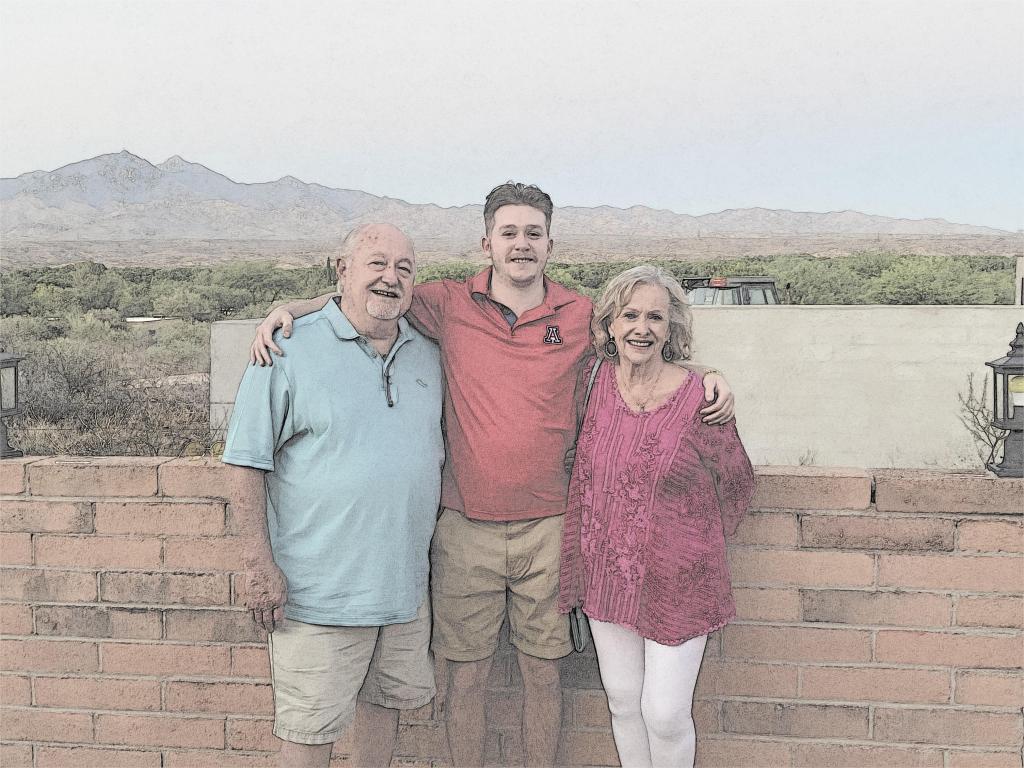
It was nice having Cooper at home with us. We enjoyed his company. He did not spend a lot of time with us upstairs, but we did eat meals together on Sundays. Grandma and grandpa usually drove over and ate Sunday dinner with us, which was nice because Cooper was able to spend quality time with his grandfather before he died of Parkinson’s in May.
(Incidentally, I do think Poppy Jack’s death was one of the more recent triggers influencing Cooper’s decision to take his own life. I will speak more about this in a future post.)
Remember, I have shared that Cooper had social anxiety. He stated in a text to a friend that his social anxiety sometimes caused him “pain” to talk with others. In another text, Cooper mentioned he saw a doctor, and the doctor suggested he might be depressed. On the heels of COVID-19, I know Cooper felt lonely and isolated because he told me so (November 2021).
Cooper, like all of us, wanted to connect with others. He wanted companionship. He wanted a girlfriend. But Cooper was not great at connecting and starting that first initial conversation. It was hard for him. For those who got through that initial social awkwardness and accepted Cooper as he was, he was deeply loved.
As I was going through Cooper’s text messages looking for clues as to why he might have taken his life, and if it was preplanned (it was not), I came across a text exchange, several months old, that bothered me. It continues to bother me, which is why I am writing about it.
I don’t believe the text exchange had anything to do with Cooper taking his life, but I don’t think it helped either. It was another small lash for a young man who was struggling.
The text exchange is between Cooper and a girl he had just met. To keep it simple, the girl laughs Cooper off and ridicules him for living in his “parents’ basement.”
The text exchange hurts me on several levels.
First, being made fun of and ridiculed when I now know Cooper was hurting hurts me. But secondly, the exchange so easily glosses over what I have shared with my children regarding living together, two- or three-generations deep, based on how I have experienced life.
I have expressed to my children over the years that white culture, in regard to shipping their children off to college with the expectation they never come home, is limited and that we ought to be more open to adopting the healthy practices of multigenerational living found in different cultures.
I shared with Cooper over the last year that there is nothing wrong—nothing at all—with a young man living at home for a season of life to gain a financial foothold and make a better future for himself and his future family.
At 23 years of age, Cooper was judged by an arrogant young woman for living with his parents in their “basement.” Never mind that it was his home too, that he had moved to a new town a year ago, and that the “basement” rivals modern apartments.
This mean girl piled on when she didn’t need to.
I want to pause and reinforce: everybody we meet and come into contact with, make eye contact with, or have a conversation with may be deeply hurting. They may be alone and isolated, anxious and depressed.
Instead of piling on, can we build up?
Ridiculing a young man for living at home in his parents’ basement is not okay. There should not be a stigma associated with boys in the basement, especially in this economy.
To the boys in the basement, I salute you. You’re doing it right. Love your parents, save your money, get a better start in life, gain a foothold. You’re doing your future family right.
Thank you for letting me get this off my chest.


 Endure
Leave a comment