During my fire department career, I was not on a special operations team. These are the teams conducting specialized rescues, like swift water rescue, confined space rescue, and high-angle rescue. I did receive “operations” level training in these disciplines and later became a rope rescue technician.
After my fire department career in Arizona, we moved to Montana. I was a faculty member in the Fire Science program at Montana State University Billings. My wife was a 1st grade teacher in the public schools. Because tuition was low-cost for faculty, I decided to take a few courses I thought would be “fun.” They were fun; I loved them. I took courses in Search & Rescue, Wilderness First Responder, and Rock Climbing I. In Montana, these are next-level courses—they are legit.
With my educational background and experience in fire department leadership, I was also teaching a few leadership courses in the Outdoor Adventure Leadership program.
As I learned more about search and rescue in the backcountry, I applied and interviewed to become a Volunteer Search & Rescue Technician with a Fire/Rescue Department near the Beartooth Mountains. I was accepted and began training. I did not finish the volunteer training program before moving to the Midwest, but I was able to complete some excellent search and rescue training, including avalanche rescue training.
I share the above to highlight a sociological theory called “edgework,” and how I have been thinking about this concept in the last few days as I continue to process my grief, sadness, and sorrow following Cooper’s death. I am not steeped in the theory of edgework; I only know it as a concept. As my Israeli friend, Eitan, says, “Let’s not let details ruin a good story, shall we?”
Edgework was originally applied to thrill-seekers pushing their physical limits right up to the edge of life and death. When you watch a Warren Miller ski film or big wave surfers, this is edgework in the physical realm. This was the original intent of the language. The rush of thrill-seekers is held right on the edge of life and death.
Jen Lois, a search and rescue technician in Colorado and researcher, began to apply this term to the emotional dynamics that search and rescue technicians experience in their work.1 She moved the meaning away from physicality and toward the mental and emotional realm. She wondered how rescuers bring their emotions and minds to the upper limits of functioning under extreme stress in backcountry rescue2.
Good rescuers need to be in mental and emotional control. They need to know their limits and recognize when they are nearing them. A rescuer beyond their upper limits serves nobody well; they become a liability and may even need rescuing, creating a greater problem—an unfortunate cascade.
Good rescuers are not thrill-seekers. This is not unlike firefighting. I never considered myself a thrill-seeker during my fire department career; quite the opposite, actually. I—we—took a very calculated approach to saving lives. There were a few times when my work took me to the edge—physically, mentally, and emotionally. In fact, upon my retirement after 25 years of service, I experienced being mentally and emotionally over the edge, and it took me a good eight months to right myself. Stress injury is for real.
In the immediate aftermath of Cooper’s death, one of my initial responses was to want to chase after him into the spirit realms. No, I did not want to end my life. I have always enjoyed living, and I still do today. It was my hardwiring as a firefighter coming out—I wanted to attempt a rescue, spiritually. If there was a thin space I could jump into and do battle with the spirits to bring Cooper back, I was willing. I was willing to fight a spiritual fire, if only I could.
Further, I did not want my son going it alone. I was trafficking in the maxim from Backdraft, the firefighting movie: “If you go, we go.” It pained me—it still pains me—that Cooper left this world alone. I know, I know. People tell me he was not alone, the Heavenlies were with him. I pray it so, but nevertheless, there was not another person in the flesh and blood with him. This greatly bothers me.
Of course, we live in reality, and there is no unwinding the clock. What is done is done. While I cannot unwind the clock, I have gone back in my spiritual imagination and prayed for Cooper in that moment, imagining I was with him. Call it holy mysticism. Yes, I know he’s still going to do his thing, and I can’t stop him, but in this spiritual imagining, he’s not alone; I am holding his hand. I don’t try to stop him, I am simply with him. This idea, of praying back in time to be with Cooper in that moment, came through a counselor with Red Bird Ministries.3 I recently had a “comfort call” with her, and she presented this idea as we were talking. It resonated with me.
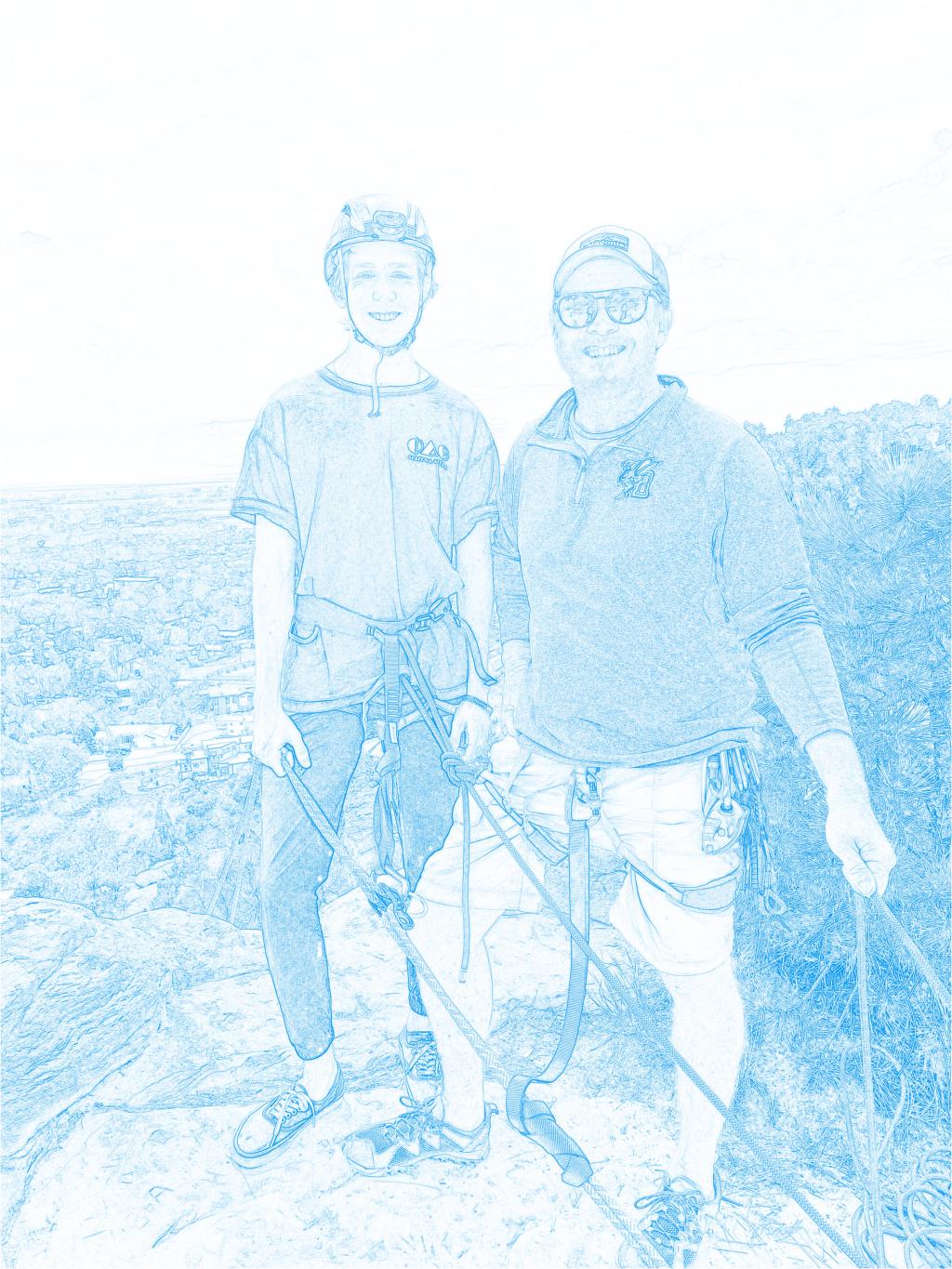
For today, and the last few weeks, I feel like what I have been doing is spiritual edgework. I keep coming back to a memory I have of setting up an anchoring system for rock climbing and rappelling. I am standing right on the edge of rock, anchored in, with Cooper. He’s getting ready to rappel. We are safe, but not entirely without risk. I am not alone. We are standing together on the edge. It’s a great day. We are together—no cell phones. Just a father, his son, and their hands, in nature, sun on the skin.
I know, because I am living it, any person who has lost someone special to them due to unexpected loss, especially suicide, is doing edgework every day in the immediate aftermath of their loss. It’s precarious spiritual space to be in.
We are standing on a spiritual edge, hopefully anchored in, hopefully not alone, peeking over into the abyss wondering what’s on the other side of this thin space, where did our loved one go, and why?
We might say, “God, Universe, Creator, I am not angry, but please, do tell.” We might add, “I may, in the future, be angry, and You will surely know, but for today, I am vexed.”
I made a comment in my last post about standing together as a noble act. I believe this.
I think it’s interesting that standing, feet shoulder-width apart, with a firm feeling of being grounded, together with others who I know care, on the edge of a cliff, is the image I have during this phase of grief.
I know I am doing spiritual edgework, poking around in spiritual areas. Some of these areas feel comfortable; others feel tenuous. As I noted, part of being a good “rescuer” is knowing your limits and stepping back from the edge. I have done this on a few occasions.
I am not thrill-seeking. I am meaning-making—trying.
The truth is, I know I am never really going to know for sure why Cooper took his own life. As I have read through Cooper’s accessible data (that I have been able to gain access to), I have gained a fuller, though not a complete, picture. What I have is a charcoal sketch, rough in the outline. I am feeling some level of contentment with this. One, I love charcoal sketches. But two, I feel I have done the due diligence I will be able to do with this chapter of the Unfolding.
What I most miss in this exploration of the spiritual edge, besides being with my son, is a faith-wisdom community—more anchors. Given the vicissitudes of life—COVID-19, moving to a new town—we have not yet established a faith-wisdom community to grow and worship with, to explore with. I am greatly sensing this gap in our life right now. This is an area I (we) need to shore up—mental note to self; and, no pun intended for the rescue audience.
How am I doing? I think okay. I have been doing spiritual edgework, I have not been alone, I am anchored in, and I have a healthy respect for my spiritual limits, including mental and emotional limits. My feet are shoulder-width apart, I am grounded, but I have been on the edge. I am comfortable here, peering over, wondering “where’s Cooper?”
I pray you are doing well. Safe edge-working to you. Let me know if you need an anchor. I am here for you too.
- Lois, Jennifer. Heroic Efforts: The Emotional Culture of Search and Rescue Volunteers. NYU Press, 2003. ↩︎
- If you’re interested in learning more about “edgework” and its principles, check out the episode Edgework from the podcast Rescue: Defying Fate, Defining Heroes, hosted by Donny Dust (June 14, 2023). Available on Apple Podcasts: https://podcasts.apple.com/us/podcast/edgework/id1571571313?i=1000617213616.” ↩︎
- Red Bird Ministries, www.redbird.love ↩︎


 Endure
Leave a comment